
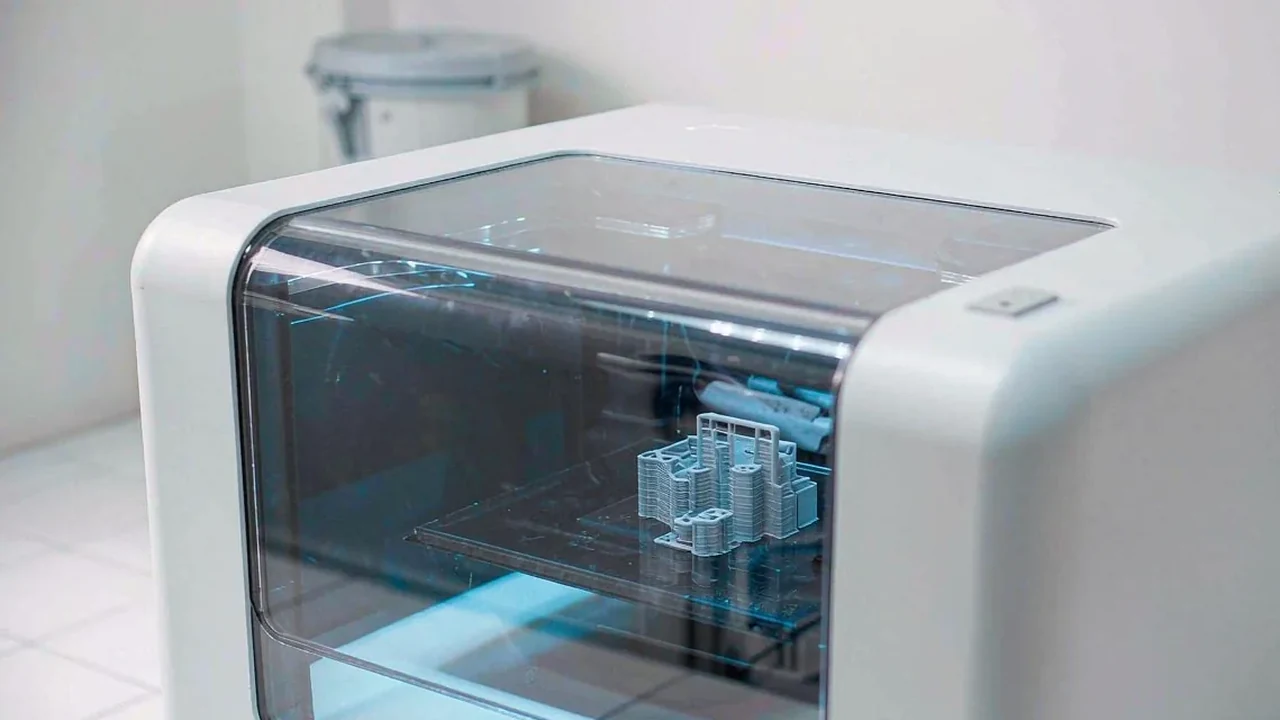
Machining removes material from a solid block; printing adds material layer by layer. That single difference explains almost every trade-off between them.
Geometry
Printing wins on complexity. Internal channels, lattice structures, organic shapes and deep undercuts are easy to print and expensive or impossible to machine. Machining wins on precision features: a reamed bore, a flat sealing face or a threaded hole is produced directly and repeatably.
Material properties
A machined part is made from the same bulk material the production part will use, so strength, stiffness and temperature behaviour are representative. A printed part is built from a different material system and is usually anisotropic — strength across layers can be lower than strength along them. For load-bearing or heat-exposed parts, machining is normally the safer choice.
Accuracy and repeatability
Machining holds tighter tolerances and repeats them part after part. Printing accuracy depends on technology, part size, orientation and supports; large parts can also warp. If a dimension must fit another part, machine it — or print an oversize feature and machine it afterwards.
Cost behaviour
Printing has almost no set-up cost, so one complex part is cheap. Machining requires programming, workholding and tooling, which is amortised over the batch. As quantity grows, machining usually becomes cheaper per part, while printing cost stays roughly linear.
Lead time
For a single simple part, printing is often faster because it needs no programming or fixtures. For a part with tight tolerances, or for a batch, machining is frequently quicker overall.
A practical decision table
- Choose printing when: geometry is complex, quantity is 1–5, material properties are not critical, and speed matters most.
- Choose machining when: tolerances are tight, real material properties are required, the part must mate with others, or quantity is above a handful.
- Combine them when: a printed shape needs accurate mounting faces, bores or threads — print the shape, machine the interfaces.
Summary: When in doubt, send the model with the critical dimensions marked. A supplier can usually tell within a short review which route suits the part, and will say if a hybrid approach is cheaper.
Need parts made to your drawing?
Request a quote